
In This Article
If you’ve narrowed your flooring search down to laminate or vinyl, you’ve already made the harder decision — both are solid, budget-friendly alternatives to hardwood or tile. The real question isn’t which one is “better.” It’s which one fits the room you’re putting it in, and that answer usually comes down to two things: how much moisture the room sees, and how much you want to spend.
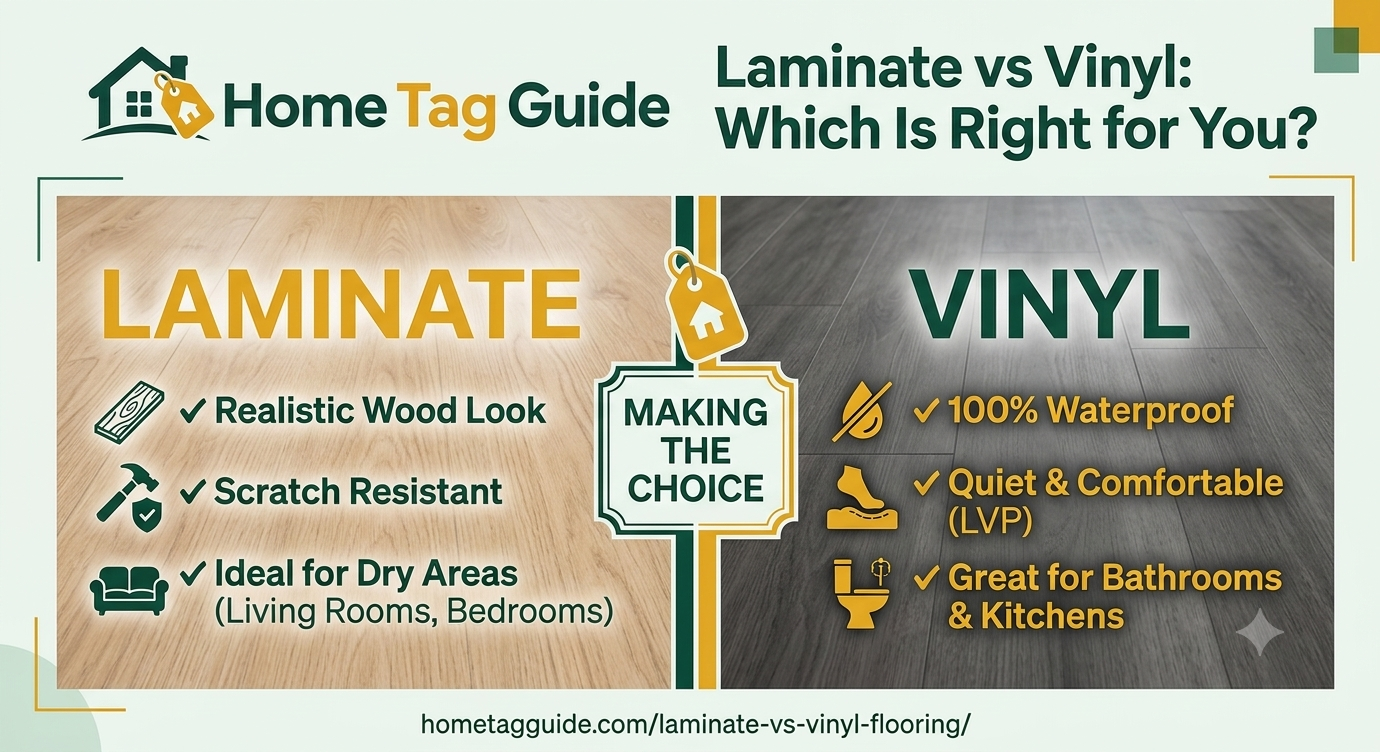
Here’s the short version: if the room ever sees standing water — a bathroom, laundry room, basement, or entryway — vinyl is the safer choice. If the room stays consistently dry — a bedroom, living room, or home office — laminate often gives you a more realistic wood look for similar money. The rest of this guide walks through why, room by room, so you can check it against your own project before you buy.
What Laminate and Vinyl Actually Are
They can look almost identical in a showroom, but they’re built from completely different materials, and that difference is the reason everything else on this page — water resistance, feel underfoot, repair options — plays out the way it does.
Laminate flooring is built from compressed wood fiberboard (sometimes called HDF, high-density fiberboard) with a printed image layer on top that mimics wood grain or stone, sealed under a clear, hard-wearing protective layer. It’s sold almost exclusively as interlocking planks that “float” over the subfloor — the planks click together and rest on top rather than being glued or nailed down. An expansion gap is left around the room’s perimeter so the boards can swell and contract slightly with humidity changes without buckling.
Vinyl flooring is a synthetic product made primarily from PVC. The version most homeowners compare directly to laminate today is luxury vinyl plank (LVP) — a multi-layer product built around a rigid core (commonly SPC, stone plastic composite, or WPC, wood plastic composite), topped with a printed design layer and a clear wear layer. Vinyl also comes as sheet flooring and vinyl tile, both cheaper than LVP but less common for a full room because sheet vinyl is harder to install cleanly and shows seams.
Because both are printed products designed to mimic wood, price and photos alone won’t tell them apart. Performance is where they diverge.
Water Resistance: The Factor That Decides Most Cases
This is where the decision usually makes itself, so it’s worth understanding clearly before you look at anything else.
Vinyl, particularly LVP with an SPC or WPC core, is fully waterproof. The core material itself doesn’t absorb water, so it can handle standing water, a spill left overnight, or a slow appliance leak without the planks warping or swelling. That makes it a genuinely safe choice for kitchens, bathrooms, laundry rooms, mudrooms, and basements — rooms where water exposure isn’t a hypothetical, it’s a matter of when, not if.
Laminate is different at a material level, not just a marketing level. Its core is compressed wood fiber, and wood fiber absorbs water by nature. Manufacturers have gotten much better at water-resistant laminate over the last several years — many products can now handle a spill that’s wiped up within a reasonable window — but “water-resistant” and “waterproof” are not the same claim. Standing water left overnight, a bathroom overflow, or a flooded basement will still cause the fiberboard core to swell, warp, or delaminate at the seams. Once that happens, the affected planks typically need to be replaced rather than repaired, and if the water tracked underneath surrounding boards, the damage can spread further than the original spill.
If there’s any realistic chance of standing water in the room — not “we’ll be careful,” but “this room has plumbing, this room floods occasionally, this room has kids and pets” — vinyl is the lower-risk choice, and it’s not close. For genuinely dry rooms, this factor becomes a non-issue and the decision moves to the criteria below.
Cost: What You’ll Actually Pay
Pricing for both materials spans a wide range depending on product tier, brand, and where you live, so treat any single “average cost” figure you see online with some skepticism — a lot of pages quote a number that only applies to one specific product line. As a realistic planning range for installed cost (material plus professional labor):
- Laminate: roughly $3–$8 per square foot for most mid-range products. Basic entry-level laminate can run close to $1 per square foot for material alone, while premium, highly realistic laminate (thicker cores, embossed-in-register texture that lines up with the printed grain) can push installed cost toward $12–$14 per square foot.
- Vinyl (LVP): roughly $3–$10 per square foot for most mid-range products. Sheet vinyl is considerably cheaper, sometimes near $1 per square foot installed for the most basic options, while premium waterproof LVP with a thick wear layer can run $14–$16 per square foot installed.
At the entry level, laminate tends to be slightly cheaper. At the mid-range — where most homeowners actually shop — the two are close enough that cost alone rarely settles the comparison. Moisture exposure and the look you want typically matter more than the per-square-foot gap.
A rough real-world example: for a 300-square-foot living room, mid-range laminate installed might run somewhere around $900–$2,400, and mid-range LVP somewhere around $900–$3,000. For a 60-square-foot bathroom, the total dollar difference between the two materials is small in absolute terms — which is part of why moisture resistance, not price, should usually decide flooring for small wet rooms.
Whichever material you choose, budget an additional $1–$2 per square foot for extras that apply to both: underlayment or a moisture barrier, transition strips between rooms and at doorways, new baseboards or shoe molding if the old ones don’t match, and removal and disposal of your existing flooring. These are easy to forget when comparing sticker prices side by side, and they apply almost regardless of which material you pick.
If you want a number specific to your actual room dimensions rather than a general range, HomeTagGuide’s Flooring Calculator will work out the material quantity you need — pair that with the per-square-foot ranges above for a rough budget, or the Tile Calculator if you’re comparing against a tile option for a wet room.
Durability and Lifespan
Both materials are built for everyday wear, not delicacy, and both commonly last 15 to 25 years in normal residential use — a wider range than most single-number claims suggest, because product quality varies enormously within each category.
Within that range, quality tier matters more than which material you chose. Laminate rated AC4 or AC5 — an industry abrasion-resistance rating you’ll see on packaging — can actually outlast mid-range LVP by roughly 5 to 10 years in rooms that stay consistently dry, thanks to a harder wear layer that resists scratching from foot traffic and furniture. Vinyl’s real advantage isn’t raw lifespan in ideal conditions — it’s that moisture doesn’t shorten its lifespan the way it can with laminate, so its worst-case lifespan in a humid or wet-prone room is much better than laminate’s worst case in the same room.
Neither material can be refinished once it wears out, unlike solid hardwood, which can be sanded and refinished multiple times over its life. When either laminate or vinyl reaches the end of its usable life, you’re replacing it, not restoring it. If you’re flooring a rental property or a home you plan to sell within a few years, that’s worth weighing — the cheaper option often makes more practical sense when you won’t personally be living with the long-term durability trade-off.
Maintenance and Cleaning
Day-to-day care is where vinyl’s waterproof core pays off in a second way, beyond flood protection.
Vinyl can be swept, vacuumed, and damp- or wet-mopped without hesitation. Because the core doesn’t absorb water, there’s no risk of overdoing it with a mop. Most manufacturers recommend a mild cleaner and avoiding harsh abrasives or ammonia-based products that can dull the wear layer, but beyond that, cleaning vinyl is close to foolproof.
Laminate requires a more careful hand. Sweeping and vacuuming are fine, and a damp — not wet — mop is generally safe for routine cleaning, but excess water left sitting on the surface can seep into the seams between planks and reach the fiberboard core underneath, which is exactly the failure mode described in the water resistance section above. Laminate-specific cleaning products (rather than generic all-purpose floor cleaners) are usually recommended to avoid leaving a residue or damaging the finish.
Neither material needs the periodic refinishing that hardwood does, and both are considered low-maintenance compared to natural materials. The practical difference is really about margin for error: vinyl tolerates a heavier hand with water; laminate does not.
Repairability
If a plank gets damaged — a dropped appliance, a deep gouge, water damage that slipped past your attention — the two materials differ in how easy that is to fix.
Vinyl plank flooring, particularly click-lock LVP, can often have individual damaged planks replaced without disturbing the whole floor, especially if you kept a few spare planks from the original installation (a good practice regardless of which material you choose). Glue-down vinyl is more involved to spot-repair but still generally more forgiving than laminate in this respect.
Laminate repairs are typically more disruptive. Because floating laminate floors interlock along their full length, replacing a single damaged plank in the middle of a room often means carefully working back from the nearest wall to reach it, which can turn a small repair into a larger job — especially in older installations where the exact product may no longer be available to match.
Comfort, Sound, and Feel Underfoot
Vinyl is generally softer and slightly warmer underfoot than laminate, which matters in rooms where people spend a lot of time standing — kitchens especially. It also tends to be quieter: footsteps, dropped items, and pet claws make less noise on vinyl than on laminate, particularly a floating laminate installation without a sound-dampening underlayment.
Laminate feels firmer underfoot and can sound noticeably hollow when walked on if it’s installed over a thin or low-quality underlayment. A better underlayment closes much of this gap and is worth budgeting for if sound is a real concern in your household — it’s a relatively small added cost for a meaningfully different day-to-day experience, particularly in a second-story room or a home with an open floor plan where sound carries.
Environmental and Indoor Air Quality Considerations
Both materials can emit volatile organic compounds (VOCs), particularly in the period shortly after installation, and levels vary significantly by manufacturer and product line rather than by material category alone. If indoor air quality is a priority, look for products certified by an independent program such as FloorScore or GREENGUARD Gold, and ventilate the room well for the first few days after installation regardless of which flooring you choose.
On raw materials: laminate’s wood-fiber core generally makes it the more recyclable option in principle, and some product lines use recycled wood fiber in manufacturing, though actual recycling access depends heavily on local facilities and shouldn’t be assumed. Older laminate manufacturing sometimes involved formaldehyde-based adhesives; most current mainstream products have moved to low-VOC formulations, but it’s a reasonable question to ask a retailer about a specific product if you’re sensitive to it. Vinyl is petroleum-based (PVC), which raises separate environmental considerations around raw material sourcing and end-of-life disposal, though modern vinyl flooring is largely phthalate-free and some lines incorporate recycled content.
Neither material is a clear environmental winner across every dimension — the honest summary is that both have trade-offs, and checking for a specific low-VOC or GREENGUARD certification on the exact product you’re buying tells you more than the material category does.
Appearance and Design Realism
Modern printing technology has closed much of the visual gap between these two materials and real hardwood, but they achieve realism differently.
Laminate is often considered slightly more convincing at replicating the texture and depth of real wood grain, particularly in higher-end lines that use embossed-in-register (EIR) technology — a process that aligns the physical texture of the plank surface with the printed image beneath it, so the grain you see lines up with the grain you feel.
Vinyl has made substantial design advances as well, with 3D printing techniques and textured finishes producing convincing wood, tile, and stone looks across a wide range of colors and plank widths. Where vinyl has a practical edge is in wet-look or high-gloss stone and tile replication, since it doesn’t need to work around a wood-based core.
In practice, at the mid-range and above, most homeowners find both materials visually convincing in person — the appearance gap matters most at the cheapest end of either category, where thinner wear layers and lower-resolution printing are more noticeable underfoot and in raking light.
Installation and DIY Difficulty
Both materials are among the more DIY-friendly flooring options available, which is part of why they’ve become popular for renovations rather than hardwood or tile.
Laminate installs almost universally as a floating floor: planks click together along their edges and rest over the subfloor, with an expansion gap left around the room’s perimeter (covered later by trim or baseboards) to allow for natural swelling and contraction with humidity. It’s a well-documented process that a reasonably confident DIYer can manage in a straightforward, rectangular room over a weekend.
Vinyl offers more installation methods, which is convenient but also means the difficulty varies more by product:
- Peel-and-stick is the simplest option and the most beginner-friendly of the three.
- Floating click-lock LVP installs similarly to laminate and is a comparable DIY project.
- Full glue-down vinyl gives the most secure, commercial-grade result but is generally better left to a professional, especially across a larger room, since getting adhesive coverage and seam alignment right is less forgiving of small mistakes.
Before assuming either project is a weekend DIY job, check which installation method your specific product uses — “vinyl flooring” alone doesn’t tell you that, and it’s the detail that actually determines how involved the install will be.
Resale Value
Neither laminate nor vinyl carries the resale premium that solid hardwood does, but both are generally viewed neutrally to positively by buyers compared to older, worn flooring or dated carpet — particularly higher-end laminate with a convincing wood look, which some buyers struggle to distinguish from engineered hardwood at a glance. If resale value specifically is a priority and budget allows, engineered hardwood sits above both options in typical buyer perception, but that’s a different comparison from the one covered here.
Pet Considerations
For households with pets, vinyl has a fairly clear practical edge. It’s fully waterproof, so accidents aren’t a crisis the way they can be on laminate. It’s softer underfoot, which is gentler on older pets’ joints. And it tends to be more forgiving of consistent claw traffic than laminate, which can show wear patterns near doorways and high-traffic paths over time.
That said, both materials benefit from the same basic precautions: keep nails trimmed, wipe up accidents promptly rather than leaving them, and use furniture pads under heavy pieces to prevent dents — vinyl is softer, which also means it can dent more easily under concentrated weight like an unpadded chair leg.
Which One for Which Room
| Room Type | Better Choice | Why |
| Bathroom, laundry room | Vinyl | Fully waterproof; handles standing water and leaks without core damage |
| Kitchen | Vinyl | Spill and leak protection, plus softer, quieter underfoot for standing time |
| Basement | Vinyl | Moisture and occasional flooding risk make this close to a non-negotiable |
| Entryway, mudroom | Vinyl | Tracked-in water, slush, and heavy foot traffic |
| Living room, dining room | Either — laminate often preferred | Consistently dry; laminate’s realistic wood texture and firmer feel are assets here |
| Bedroom | Either — laminate often preferred | Low moisture risk; look and firmness typically matter more than sound-dampening here |
| Home office | Either | Dry room; comes down to budget and aesthetic preference more than performance |
Common Mistakes to Avoid
- Choosing based on price alone. At the mid-range, the cost difference between the two materials is often small enough that it shouldn’t override a genuine moisture risk in the room.
- Assuming “water-resistant” laminate means waterproof. It doesn’t. Water-resistant laminate buys you time to clean up a spill — it doesn’t make the room safe for standing water or regular moisture exposure.
- Skipping the underlayment to save money. This affects sound, comfort, and — for laminate specifically — can affect moisture protection if a vapor barrier is skipped over concrete subfloors.
- Not checking the installation method before buying vinyl. “Vinyl flooring” covers peel-and-stick, click-lock, and glue-down products with meaningfully different DIY difficulty. Confirm which one you’re buying before assuming the project scope.
- Using one material throughout an entire home without room-by-room thought. There’s no rule requiring consistency across every room, and matching material to moisture exposure room by room usually produces a better long-term result than picking one flooring type for the whole house.
Frequently Asked Questions
Can I install vinyl or laminate over an existing floor?
Often yes, provided the existing floor is flat, stable, and clean — a common approach over existing vinyl, tile, or a properly prepped concrete slab. Uneven or damaged subfloors typically need leveling first regardless of which material you choose, since both are unforgiving of an uneven surface underneath.
Is vinyl plank actually as good as hardwood?
For water resistance and cost, LVP is a clear upgrade over solid hardwood, since hardwood is not waterproof and costs considerably more. For resale value and long-term refinishing potential, hardwood still has an edge. Which one is “better” depends on whether waterproofing and budget or long-term resale premium matters more for your specific home.
Do I need different underlayment for laminate versus vinyl?
Generally yes — laminate typically needs an underlayment that includes a vapor barrier when installed over concrete, to protect the wood-fiber core from ground moisture. Vinyl’s underlayment needs vary more by product and are often built into click-lock LVP planks already, so check your specific product’s installation instructions rather than assuming one underlayment works for both.
Bottom Line
Start with the room, not the material. If there’s any realistic chance of standing water — a leak, a spill that might sit, a flood risk — choose vinyl and don’t spend much more time deliberating; the water-resistance gap is too large to reason around with careful cleaning habits alone. If the room is reliably dry, laminate is a strong, often slightly more budget-friendly option, particularly if a convincing wood look matters more to you than a marginally softer, quieter floor.
If you’re flooring an entire home with a mix of room types, using both materials — vinyl in wet-prone areas, laminate in dry living spaces — is common and often the better outcome than picking a single material for every room. For a budget check against your actual square footage, HomeTagGuide’s Flooring Calculator can help you work out material quantities before you buy, and the Best Flooring Options for Your Home buying guide is a good next stop if you’re still weighing flooring types beyond just these two.
Explore More in Flooring
Budget planning resources
View Cost Guides →Ideas for every space
View Inspiration →Honest product reviews
View Reviews →