Table of Contents
- Executive Summary & Market Benchmarks
- Comparative Flooring Performance Matrix
- Detailed Category & Material Analysis
- Room-by-Room Flooring Selection Guide
- Subfloor Preparation & Installation Methodologies
- DIY vs. Professional Installation Cost Analysis
- Essential Maintenance & Care Protocols
- Summary & Final Recommendation
Top Picks
Porcelain & Vitrified Tile
Luxury Vinyl Plank (SPC)
Engineered Hardwood
Laminate Flooring
Natural Marble Tile
Selecting the optimal flooring material for a home is a fundamental decision that directly impacts interior design, routine maintenance, structural longevity, and overall property value. With continuous advancements in material engineering—from rigid-core composites to high-definition digital printing on vitrified tiles—homeowners now have access to a broader spectrum of performance-focused, aesthetically versatile options than ever before.
This comprehensive guide breaks down the primary residential flooring categories, performance matrices, room-by-room recommendations, pricing benchmarks, installation methodologies, and routine maintenance protocols.
Executive Summary & Market Benchmarks
Choosing residential flooring requires balancing aesthetic preference against functional realities, such as traffic volume, subfloor type, moisture levels, and budget. Across major residential markets, total installed costs span from budget-friendly resilient surfaces ($3 to $7 / sq. ft.) to ultra-premium natural stones and hardwoods ($15 to $35+ / sq. ft.).
Key Selection Identifiers
-
Most Durable Overall: Porcelain & Vitrified Tiles (unmatched scratch, stain, and moisture resistance).
-
Best High-Traffic & Utility: Luxury Vinyl Plank / Stone Plastic Composite (100% waterproof, warm, resilient).
-
Highest Return on Investment (ROI): Solid & Engineered Hardwood (enhances long-term home resale value).
-
Best Budget-to-Performance Ratio: Laminate & High-Grade LVP.
-
Labor vs. Material Cost Ratio: 40%–60% Materials | 40%–60% Labor & Subfloor Prep (varies by material weight and complexity).
Comparative Flooring Performance Matrix
The table below outlines key technical characteristics, price ranges, and suitability metrics across all primary residential flooring types:
Detailed Category & Material Analysis
A. Porcelain & Vitrified Tiles
Porcelain and vitrified tiles are crafted from ultra-fine clay fired at extreme temperatures, resulting in dense, non-porous planks or slabs. Vitrified tiles utilize liquid silica and clay fused during manufacturing to form a glass-like structure with water absorption rates below 0.5%.
-
Pros: Complete immunity to standing water; fireproof; allergen-free; accepts radiant underfloor heating seamlessly; available in large-format slabs (up to 4′ x 8′) mimicking natural stone or timber.
-
Cons: Hard underfoot, leading to standing fatigue; cold without radiant heating; heavy structural weight requiring rigid, deflection-free subfloors.
-
Best Suited For: Bathrooms, kitchens, mudrooms, covered patios, and high-foot-traffic main corridors.
B. Luxury Vinyl Plank (LVP) & Stone Plastic Composite (SPC)
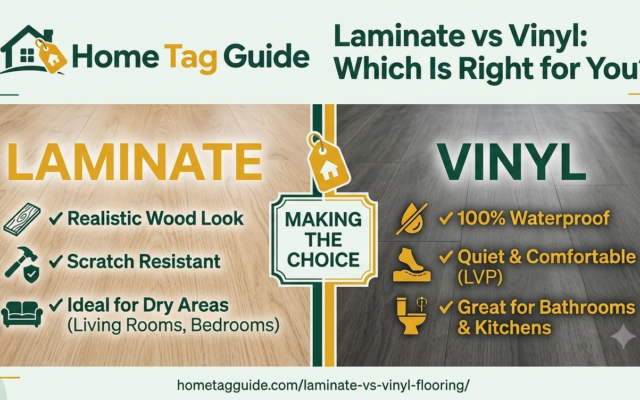
Luxury Vinyl Plank consists of multiple synthetic layers, including a rigid core, a high-definition decorative vinyl print film, and a clear protective wear layer (typically 12 to 28 mil thick). SPC rigid-core variants incorporate limestone powder into the core, offering superior impact resistance and thermal stability.
-
Pros: 100% waterproof construction; soft and quiet underfoot due to integrated foam or cork underlayment; simple click-lock DIY installation; highly resistant to pet claws and minor spills.
-
Cons: Cannot be sanded or refinished if deeply damaged; non-biodegradable synthetic composition; lower resale value impact compared to real wood or stone.
-
Best Suited For: Basements, active family rooms, pet-friendly households, utility spaces, and rental properties.
C. Engineered Hardwood
Engineered hardwood features a real natural wood wear layer (veneer) bonded under heat and pressure to a multi-ply cross-grained plywood or high-density fiberboard (HDF) core. This cross-ply architecture neutralizes wood’s natural tendency to expand and contract with ambient humidity changes.
-
Pros: Authentic real-wood look and grain texture; enhanced dimensional stability over concrete slabs or below-grade spaces; can be sanded and refinished 1 to 3 times depending on veneer thickness.
-
Cons: Higher cost profile than synthetic look-alikes; susceptible to surface gouging from sharp heels or unclipped dog nails; not suitable for wet bathrooms.
-
Best Suited For: Main living areas, master suites, formal dining rooms, and dry-climate residences.
D. Solid Hardwood
Milled from a single piece of solid timber (e.g., Oak, Maple, Walnut, Teak), solid hardwood represents the traditional gold standard in residential flooring. It is typically nailed or stapled directly to a wooden subfloor.
-
Pros: Legendary longevity (can last over a century); can be sanded and refinished 5 to 8+ times to alter stain colors or remove wear; significant value add for real estate appraisals.
-
Cons: Highly sensitive to moisture, humidity, and standing water (warps, cups, or buckles); expensive material and specialized labor costs; cannot be installed directly over concrete slabs without a subfloor system.
-
Best Suited For: Above-grade living areas, hallways, and bedrooms in climate-controlled environments.
E. Laminate Flooring
Modern laminate uses a dense HDF core capped with a photographic image layer under a clear melamine resin wear layer. Premium options feature embossed-in-register (EIR) textures that align surface grain grooves with the underlying photo print.
-
Pros: Outstanding scratch and dent resistance (rated AC3 through AC5); economical material pricing; easy click-together floating floor installation.
-
Cons: Core swells permanently if water penetrates unsealed plank joints; loud/hollow acoustic signature if installed without high-grade underlayment; cannot be refinished.
-
Best Suited For: Budget-conscious renovations, home offices, dry bedrooms, and low-moisture living spaces.
F. Natural Stone (Marble, Granite, Slate)
Natural stone tiles are quarried directly from the earth, cut into dimensional slabs, and finished with polished, honed, or tumbled surfaces.
-
Pros: Timeless luxury aesthetic; unique individual slab patterns; excellent thermal mass for hot climates or radiant heating.
-
Cons: High material and installation expense; natural porosity requires routine sealing to prevent staining; susceptible to etching from acidic liquids (e.g., juice, vinegar, wine).
-
Best Suited For: Premium foyers, luxury bathrooms, accent walls, and custom architectural homes.
Room-by-Room Flooring Selection Guide
1. Kitchens & Wet Prep Zones
Kitchen floors endure continuous foot traffic, dropped utensils, grease splatters, and water spills.
-
Best Pick: Large-format porcelain/vitrified tiles with stain-proof epoxy grout, or 100% waterproof SPC rigid vinyl plank.
-
Avoid: Unsealed natural stone, low-density laminate, and solid hardwood.
2. Bathrooms & Powder Rooms
Bathrooms experience extreme humidity swings, steam condensation, and direct standing water.
-
Best Pick: Anti-skid porcelain or ceramic tiles with textured or matte surfaces (slip resistance rating of R10 or higher).
-
Avoid: Solid hardwood, standard laminate, and non-waterproof carpet.
3. Living Rooms, Family Rooms & Foyers
Public living spaces demand high visual impact paired with durability for entertaining and daily family life.
-
Best Pick: Engineered hardwood for classic elegance, or vitrified tiles/polished natural stone for grand open-plan layouts.
-
Avoid: Low-tier thin sheet vinyl or low-wear laminate.
4. Bedrooms & Private Quarters
Bedrooms prioritize acoustic dampening, comfort underfoot, and warmth.
-
Best Pick: Engineered hardwood, plush low-VOC wall-to-wall carpeting, or SPC vinyl paired with an acoustic rubber/cork underlayment.
-
Avoid: Cold, unheated polished tiles or hard natural stone in colder climates.
5. Basements & Below-Grade Space
Sub-grade spaces suffer from ambient ground vapor, concrete moisture emission, and potential flooding risks.
-
Best Pick: Click-lock SPC vinyl over a dedicated polyethylene vapor barrier.
-
Avoid: Solid hardwood, glued-down carpet, or wood-core laminate.
Subfloor Preparation & Installation Methodologies
A high-performance floor is only as stable as the subfloor beneath it. Skipping proper prep is the leading cause of floor failure, hollow sounds, joint separation, and squeaking.
-
1. Levelness Tolerances: Floating floor systems (LVP, Laminate, Engineered) require a subfloor flat to within 3/16 inch over a 10-foot radius (or 1/8 inch over 6 feet). High spots must be ground down, and low spots filled with self-leveling underlayment compound.
-
2. Moisture Testing: Concrete slabs must undergo Calcium Chloride testing (MVT) or Relative Humidity (RH) probe testing before installing wood or vinyl. Readings above 75%–80% RH require a liquid epoxy moisture mitigation membrane.
-
3. Acclimation Period: Natural wood products (solid and engineered hardwood) must acclimate in the closed installation environment for 3 to 7 days prior to installation to match the home’s ambient equilibrium moisture content (EMC).
DIY vs. Professional Installation Cost Analysis
While click-lock materials allow competent DIYers to eliminate labor costs, heavier or specialized materials require professional equipment and trade expertise.
A. DIY-Friendly Options
-
Suitable Materials: Laminate & LVP/SPC Click Planks require basic tools (utility knife, tapping block, pull bar, miter saw). No wet adhesives or complex fasteners needed.
-
Savings Potential: $2.00 to $5.00 per sq. ft. in labor savings.
B. Professional-Required Options
-
Complex Materials: Porcelain Slabs, Tile, Marble & Nail-Down Solid Hardwood require wet saws, tile leveling clip systems, pneumatic floor nailers, and specialized thinset mixing.
-
Professional Value Add: Guarantees flat alignment, clean doorway transitions, proper expansion spacing along walls, and coverage under contractor warranties.
Essential Maintenance & Care Protocols
-
Hardwood & Engineered Wood: Sweep or vacuum weekly using a soft brush attachment (no beater bar). Clean spills immediately; mop with specialized wood cleaner only. Avoid steam mops and harsh ammonia-based cleaners. Place felt protection pads under all heavy furniture legs.
-
Porcelain & Vitrified Tile: Sweep or vacuum dust regularly to prevent grit abrasion on glazes. Damp mop with pH-neutral tile cleaner or warm water. Re-seal porous grout lines every 12 to 24 months to prevent staining.
-
Luxury Vinyl (LVP / SPC): Sweep or dust mop routinely. Damp mop with non-abrasive floor cleaners. Avoid rubber-backed mats (can cause chemical yellowing on vinyl surfaces).
-
Natural Marble & Stone: Clean strictly with pH-neutral stone soaps. Penetrating sealer application required every 6 to 12 months. Clean spills immediately—acidic liquids etch polished surfaces fast.
Summary & Final Recommendation
Selecting the best flooring for your home requires matching material strengths to room conditions:
-
For unbeatable waterproofing and easy upkeep in utility spaces or kitchens, choose Porcelain Tile or SPC Rigid Vinyl Plank.
-
For authentic warmth and maximum long-term resale value, choose Engineered or Solid Hardwood.
-
For high durability on a tight budget, opt for AC4-rated Laminate or Mid-Grade LVP.
Always ensure subfloor flatness, account for moisture mitigation, and factor in a 10% material wastage buffer when ordering your materials.